
Platelet-Rich Plasma (PRP) Therapy
A treatment option that uses your own blood for selected joint, tendon, and ligament conditions

The details
At Spine & Rehabilitation Medicine Associates, we focus on non-surgical care for musculoskeletal pain. Platelet-rich plasma (PRP) is one option we may discuss with patients who have ongoing pain from certain joint and soft-tissue conditions, especially if conservative care has not given enough relief.
What is PRP?
Platelet-rich plasma is a concentrated portion of your own blood. Platelets are best known for their role in clotting. They also contain growth factors and other proteins that take part in the body’s normal response to tissue injury.
To prepare PRP, we draw a small amount of your blood and process it in a centrifuge. This separates the platelets from other blood components. The concentrated platelets are then injected into or around the area being treated.
Because PRP comes from your own body (it is autologous), the risk of allergic reaction or rejection is low.
Conditions PRP may be considered for
Depending on your diagnosis, exam, and imaging, PRP may be discussed as an option for:
- Knee osteoarthritis and other degenerative joint conditions
- Tennis elbow (lateral epicondylitis) and golfer’s elbow
- Rotator cuff tendinopathy and partial tears
- Patellar tendinopathy (jumper’s knee)
- Achilles tendinopathy
- Plantar fasciitis
- Hamstring and other muscle–tendon injuries
- Ligament sprains that have been slow to recover
What the research shows
Most of the published research on PRP is in knee osteoarthritis and chronic tennis elbow. Several studies and reviews report benefit, especially compared with other injections, but not all do, and professional societies differ: some support considering PRP, while others recommend against it. For other conditions, study results are mixed or still developing. Results also vary between individual patients. During your consultation, we will go over what is known for your specific condition so you can make an informed decision.
What to expect

Consultation
We review your history, examine you, and look at any imaging. We discuss whether PRP is a reasonable option for you, what other treatments are available, and what results you can realistically expect.
Blood draw
A small sample of blood is drawn from your arm, similar to a routine blood test.
Processing
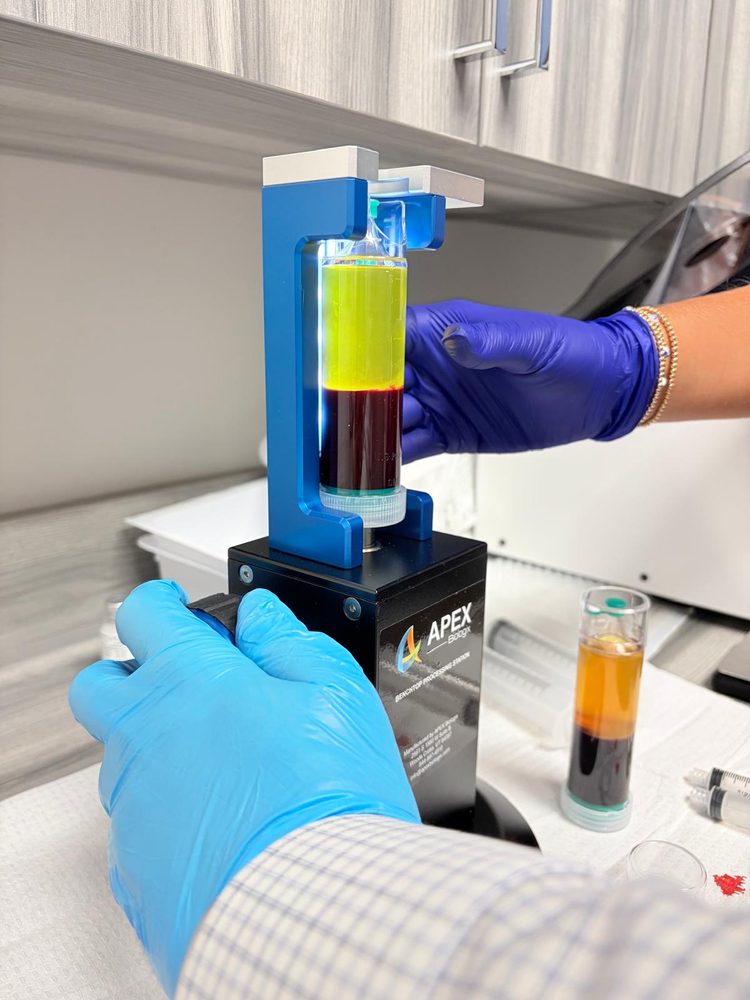
Your blood is processed on site in a closed, single-use system that concentrates the platelets. This takes about 10–15 minutes.
Injection
The treatment area is cleaned and numbed. When appropriate, we use ultrasound guidance to help place the injection accurately.

Recovery
Most patients go home the same day. Soreness at the injection site for a few days is common. We will give you specific instructions, which may include:
- Avoiding anti-inflammatory medications (such as ibuprofen or naproxen) for a period before and after treatment
- Limiting strenuous activity for a short time
- Following a guided rehabilitation or physical therapy program
Any improvement usually develops gradually over weeks rather than right away. Some patients need more than one treatment. Others may not respond.
Risks and side effects
PRP is generally well tolerated. Like any injection, it has risks, including:
- Pain, swelling, or bruising at the injection site
- A temporary increase in pain after the procedure
- Infection (uncommon)
- Bleeding
- Injury to nearby nerves or tissue (rare)
PRP may not be appropriate if you have certain blood disorders, low platelet counts, an active infection, active cancer, or are taking certain anticoagulant medications. Please tell us about all of your medical conditions and medications.
The system we use
We prepare PRP with the XCELL PRP System from APEX Biologix. Each kit is sterile and single-use, and your blood is processed in a closed system right here in the office. After a single spin in the centrifuge, the platelet-rich layer is collected using the kit’s measured markings, which helps us prepare your PRP consistently each time. The system is designed to yield a higher concentration of platelets, so more of your own platelets go into each treatment. The XCELL PRP System is cleared by the FDA (510(k) BK180252).
Regulatory information
The system we use to prepare PRP is cleared by the U.S. Food and Drug Administration (FDA) for preparing platelet-rich plasma from a patient’s blood. Using PRP injections to treat musculoskeletal conditions is considered off-label: it is a decision made by a physician, based on clinical judgment, and it has not been specifically approved by the FDA. PRP is not a stem cell treatment.
Insurance and cost
Most insurance plans, including Medicare, do not currently cover PRP for musculoskeletal conditions. We will give you clear pricing before treatment, and you can ask any questions about cost at your consultation.
Is PRP right for you?
PRP is not right for every patient or every condition. Our physicians will help you weigh it against other options, which may include physical therapy, bracing, other injections, or a surgical referral when appropriate.
References
- Belk JW, Kraeutler MJ, Houck DA, Goodrich JA, Dragoo JL, McCarty EC. Platelet-rich plasma versus hyaluronic acid for knee osteoarthritis: a systematic review and meta-analysis of randomized controlled trials. Am J Sports Med. 2021;49(1):249-260. doi:10.1177/0363546520909397
- Brophy RH, Fillingham YA. AAOS clinical practice guideline summary: management of osteoarthritis of the knee (nonarthroplasty), third edition. J Am Acad Orthop Surg. 2022;30(9):e721-e729. doi:10.5435/JAAOS-D-21-01233
- Borg-Stein J, Jayaram P, Colorado BS, et al. AAPM&R guidance statement on platelet rich plasma for knee osteoarthritis. PM R. 2026;18(suppl 2):S20-S35. doi:10.1002/pmrj.70144
- Xu Y, Li T, Wang L, Yao L, Li J, Tang X. Platelet-rich plasma has better results for long-term functional improvement and pain relief for lateral epicondylitis: a systematic review and meta-analysis of randomized controlled trials. Am J Sports Med. 2024;52(10):2646-2656. doi:10.1177/03635465231213087
- Rothrauff BB, Featherall JT, Uppstrom TJ, et al. Platelet-rich plasma in the treatment of musculoskeletal disease in 2025 and beyond. Am J Sports Med. 2026;54(8):2058-2074. doi:10.1177/03635465251395284
